

Product Overview
[Drug Name]
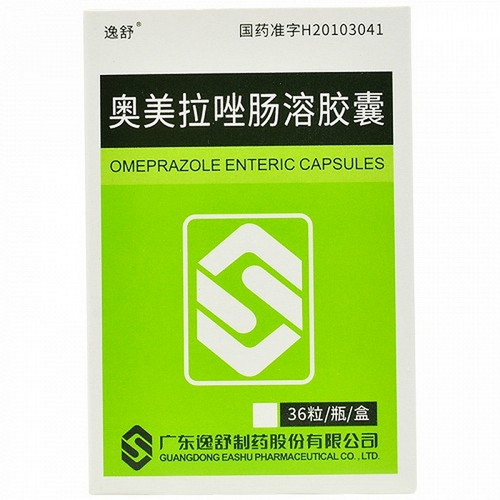
Generic Name: Omeprazole Enteric-Coated Capsules (OTC)
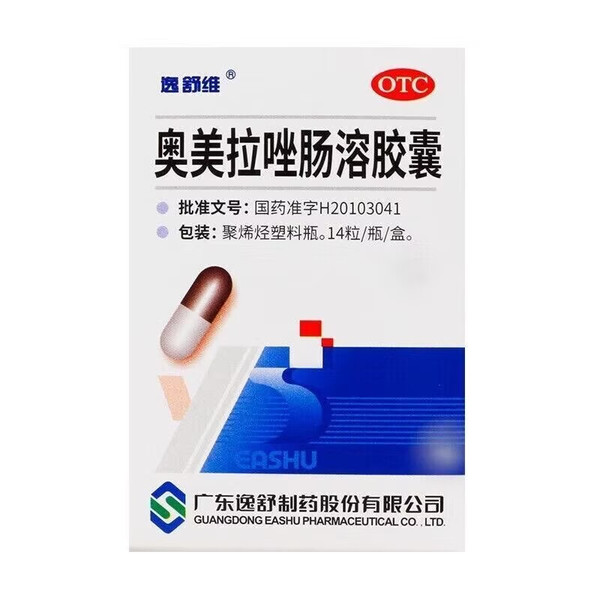
Trade Name: Yishuwei Omeprazole Enteric-Coated Capsules (OTC) 20mg*14 capsules
Pinyin Full Code: YiShuWei AoMeiLaZuoChangRongJiaoNang (OTC) 20mg*14Li
[Main Ingredients]
The main ingredient of this product is omeprazole, whose chemical name is 5-methoxy-2-[(4-methoxy-3,5-dimethyl-2-pyridyl)-methyl]-sulfinyl-1H-benzimidazole. Its chemical formula is: Molecular Formula: C₁₇H₁₇N₃O₃S. Molecular Weight: 345.42.
[Properties]
This product contains white or off-white enteric-coated pellets or granules, or an off-white powder in the form of enteric-coated capsules.
[Indications/Main Functions]
Indicated for gastric ulcers, duodenal ulcers, stress ulcers, reflux esophagitis, and Zollinger-Ellison syndrome (gastrinoma).
[Specifications]
20mg x 14 tablets
[Dosage and Administration]
Oral administration, do not chew. 1. Peptic gastric ulcer: 20mg (1 tablet at a time), 1-2 times daily. Take in the morning or once in the morning and evening. The treatment course for gastric ulcers is usually 4-8 weeks, and for duodenal ulcers is usually 2-4 weeks. 2. Reflux esophagitis: 20-60mg (1-3 tablets at a time), 1-2 times daily. Take in the morning or once in the morning and evening. The treatment course is usually 4-8 weeks. 3. Zollinger-Ellison syndrome: 60mg (3 tablets at a time), once daily. The total daily dose can be adjusted to 20-120mg (1-6 tablets) depending on the condition. If the total daily dose exceeds 80 mg (4 tablets), it should be taken in two divided doses.
[Adverse Reactions]
This drug is well tolerated. Adverse reactions may include:
1. Digestive System: Dry mouth, mild nausea, vomiting, abdominal distension, constipation, diarrhea, and abdominal pain may occur; elevations in alanine aminotransferase (ALT), aspartate aminotransferase (AST), and bilirubin may occur, but these are generally mild and transient and generally do not affect treatment. Other international data have reported that gastric mucosal cell hyperplasia or atrophic gastritis may be observed in gastric corpus biopsy specimens of patients treated with long-term omeprazole therapy.
2. Neuropsychiatric System: Paresthesias, dizziness, headaches, drowsiness, insomnia, and peripheral neuritis may occur.
3. Metabolic/Endocrine System: Long-term use of omeprazole may lead to vitamin B12 deficiency.
4. Other: Rash, gynecomastia, and hemolytic anemia may occur.
[Contraindications]
This product is contraindicated in patients with allergies, severe renal impairment, and infants.
[Precautions]
1. Use with caution in patients with renal impairment or severe hepatic impairment.
2. Effects of the drug on diagnosis: ① Omeprazole may inhibit gastric acid secretion, increasing gastric pH, which in turn triggers the secretion of gastrin by G cells in the gastric mucosa, thereby increasing blood gastrin levels. ② Omeprazole may cause false-negative results in the 13C-urea breath test (UBT). The mechanism may be a direct or indirect inhibitory effect of omeprazole on Helicobacter pylori (Hp). Clinically, the 13C-urea breath test should not be performed until at least 4 weeks after omeprazole treatment.
3. Items that should be checked or monitored before, during, and after medication use: ① Monitoring of therapeutic efficacy. When treating peptic ulcers, an endoscopic examination should be performed to determine if the ulcer has healed. When treating H. pylori-related peptic ulcers, a UBT test can be performed 4 to 6 weeks after treatment to determine if H. pylori has been eradicated. When treating Zollinger-Ellison syndrome, basal gastric acid secretion should be monitored to ensure it is less than 10 mEq/h (i.e., the treatment target). ② Toxicity monitoring: Liver function tests should be performed regularly. Long-term users should regularly examine the gastric mucosa for tumor-like hyperplasia. Serum vitamin B12 levels should also be monitored for users taking the drug for more than 3 years.
4. When treating gastric ulcers, this drug should be used only after the possibility of cancer has been ruled out. This medication can alleviate symptoms and thus delay diagnosis.
5. To prevent excessive acid suppression, long-term, high-dose use of this drug is not recommended for the treatment of general peptic ulcers (except in Zollinger-Ellison syndrome).
[Drug Interactions]
1. Omeprazole can create an alkaline environment in the stomach, reducing the absorption of drugs such as ketoconazole and itraconazole. 2. When omeprazole is used in combination with clarithromycin or erythromycin, their blood concentrations will increase. However, there is no interaction when used with metronidazole or amoxicillin. 3. Omeprazole has enzyme inhibitory properties. When used in combination with drugs metabolized by the hepatic cytochrome P450 system (CYP2C19), such as dicoumarol, warfarin, diazepam, and phenytoin, it can prolong the half-life of the latter drugs and slow their metabolism. 4. Omeprazole's acid-suppressing effect can affect iron absorption. 5. Omeprazole can alter gastric pH, thereby damaging sustained-release and controlled-release formulations and accelerating drug dissolution. 6. Drug Interaction Studies with Other Drugs: Omeprazole (20-40 mg daily) has shown that oral administration of omeprazole does not affect other related CYP isoenzymes and has no metabolic interactions with the following enzyme substrates: CYP1A2 (caffeine, phenacetin, theophylline), CYP2C9 (S-warfarin, piroxicam, diclofenac, and naproxen), CYP2D6 (metoprolol, propranolol), CYP2E1 (ethanol), and CYP3A (lidocaine, quinidine, estradiol, and budesonide).
[Pediatric Use]
There is no experience with pediatric use of this drug. It is contraindicated in infants and young children.
[Elderly Use]
Generally, no dose adjustment is required for elderly patients, but caution should be used.
[Pregnant and Lactating Women Use]
Although this drug has not been shown to be teratogenic in animal studies, it is generally contraindicated in pregnant women; it should also be used with caution in lactating women.
[Overdose]
Symptoms of overdose include blurred vision, confusion, sweating, drowsiness, dry mouth, facial flushing, headache, nausea, tachycardia or irregular heartbeat, etc. Overdose management: Primarily symptomatic and supportive. Omeprazole is not easily dialyzable; accidental overdose should be treated immediately.
[Pharmacology and Toxicology]
Proton pump inhibitor. This drug is a lipid-soluble, weakly alkaline drug that is readily concentrated in acidic environments. Therefore, after oral administration, it is specifically distributed in the secretory tubules of the gastric parietal cells. In this highly acidic environment, it is converted to its active form, the sulfenamide. It then irreversibly binds to the sulfhydryl group of the H+, K+-ATPase (also known as the proton pump) in the parietal cell secretory membrane via a disulfide bond, forming a sulfenamide-proton pump complex. This complex inhibits the enzyme's activity and blocks the final step in gastric acid secretion. Therefore, this drug has a strong and long-lasting inhibitory effect on gastric acid secretion caused by various factors.
[Pharmacokinetics]
After oral administration, this drug is absorbed through the small intestine, with onset of action within 1 hour. Peak plasma concentrations are reached in 0.5-3.5 hours, and the effects persist for over 24 hours. It is distributed to tissues such as the liver, kidneys, stomach, duodenum, and thyroid gland, and readily crosses the placenta. Bioavailability is typically approximately 35% with a single dose, increasing to approximately 60% with multiple doses. Plasma protein binding is 95%-96%, and the plasma half-life is 0.5-1 hour, or 3 hours in patients with chronic liver disease. This drug is metabolized by the hepatic microsomal cytochrome P450 oxidase system. Approximately 80% of the metabolites are excreted in the urine, with the remainder excreted in the bile and then in the feces.
[Storage]
Store in a dry, airtight container protected from light.
[Expiry Period]
24 months
[Approval Number]
National Medicine Standard H20103041
[Manufacturer]
Guangdong Eashu Pharmaceutical Co., Ltd.