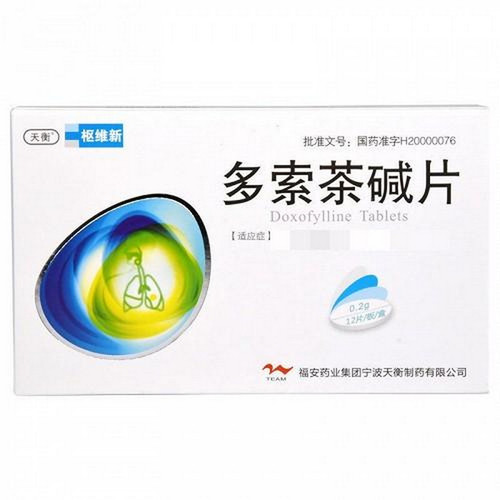
Product Overview
[Drug Name]
Generic Name: Doxofylline Tablets
Trade Name: Ansema
English Name: Doxofylline Tablets
Chinese Pinyin: Duosuochajian Pian
[Ingredients]
Doxofylline, whose chemical name is 1,3-dimethyl-7-(1,3-dioxolane-2-yl)methyl-3,7-dihydro-1H-purine-2,6-dione.
[Properties]
This product is a white or off-white tablet.
[Indications]
Dyspnea caused by bronchial asthma, asthmatic chronic bronchitis, and other bronchospasm.
[Dosage and Administration]
Oral administration: Adults usually take 0.2-0.4g twice daily, 3 hours before or after a meal. Patients with severe asthma should follow a doctor's advice. The daily dose for children is 12-18 mg/kg, or as directed by a doctor.
[Adverse Reactions]
A very small number of patients may experience symptoms such as palpitations, sinus tachycardia, upper abdominal discomfort, anorexia, nausea, vomiting, excitement, and insomnia after taking this medication.
[Contraindications]
This medication is contraindicated in patients allergic to doxofylline or xanthine derivatives, patients with acute myocardial infarction, and breastfeeding women.
[Precautions]
1. Theophylline medications vary greatly from person to person, and the optimal dosage and method of doxofylline should be determined based on individual patient conditions. 2. Patients with hyperthyroidism, sinus tachycardia, or heart rhythm disorders should follow their doctor's instructions. 3. When used in combination with fluoroquinolones, the dosage should be reduced. 4. Use with caution in pregnant women. 5. Use with caution in patients with severe cardiac, pulmonary, hepatic, or renal dysfunction, as well as active gastric or duodenal ulcers. 6. High doses may cause a decrease in blood pressure.
[Use in Special Populations]
Precautions for Children: No efficacy or safety data are available for children. Precautions for Pregnancy and Lactation: Contraindicated for use by lactating women.
Precautions for Elderly Patients: Elimination of this drug may vary in elderly patients; blood concentrations should be monitored.
[Drug Interactions]
1. Barbiturates have little effect on the metabolism of this drug. 2. In animal studies, macrolides (such as erythromycin) have little effect on the metabolism of this drug. When used in combination with fluoroquinolones such as enoxacin and ciprofloxacin, the dosage should be reduced.
[Pharmacological Actions]
1. Doxofylline is a methylxanthine derivative that relaxes bronchial smooth muscle by inhibiting phosphodiesterase in smooth muscle cells, blocking adenosine receptors, and interfering with calcium ion movement within smooth muscle cells. 2. It inhibits the release of various inflammatory mediators and cytokines, thereby controlling airway inflammation and reducing airway hyperresponsiveness.
[Storage]
Store tightly closed.
[Specifications]
0.2g
[Packaging]
0.2g x 12 tablets/box
[Expiry Life]
Tentatively 24 months
[Approval Number]
National Medicine Standard H19991048
[Manufacturer]
Heilongjiang Fuhe Huaxing Pharmaceutical Group Co., Ltd.