
Product Overview
[Drug Name]
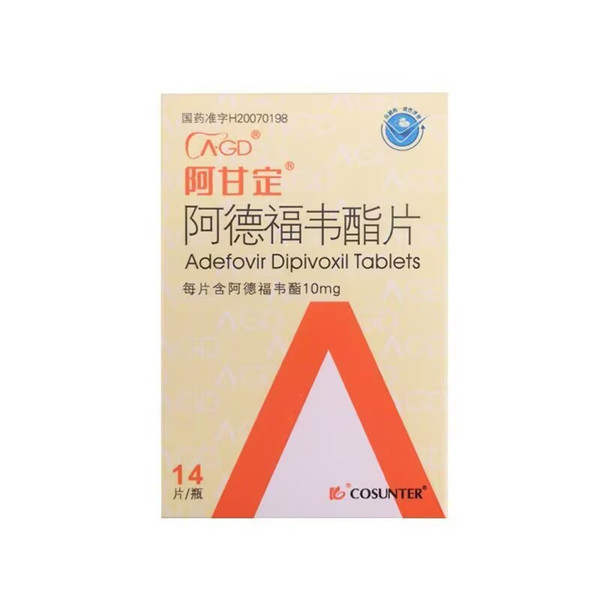
Generic Name: Adefovir Dipivoxil Tablets
Trade Name: Agandin
English Name: Adefovir Dipivoxil Tablets
Chinese Pinyin: Adefuweizhi Pian
[Ingredients]
Adefovir Dipivoxil
[Properties]
This product is an off-white tablet.
[Indications]
It is indicated for the treatment of adult patients with chronic hepatitis B who have symptoms of active hepatitis B virus replication, accompanied by persistently elevated serum aminotransferase (ALT or AST) levels, or compensated liver function with active liver histological lesions.
[Dosage and Administration]
Patients must use Adefovir Dipivoxil under the guidance of a physician experienced in treating chronic hepatitis B. The recommended dose for adults (18-65 years) is 10 mg once daily, taken orally before or after meals. The optimal duration of treatment has not been determined. Do not exceed the recommended dose. Patients should regularly monitor hepatitis B biochemical, virological, and serum markers at least every six months.
[Adverse Reactions]
Reported in the literature, common adverse reactions in international clinical studies included fatigue, headache, abdominal pain, nausea, flatulence, diarrhea, and dyspepsia. In domestic clinical studies, adverse events judged by investigators to be potentially drug-related included alopecia, rash, dizziness, headache, liver pain, flank distension, stomach discomfort, fatigue, nausea, and laboratory abnormalities (elevated ALT and CPK, leukopenia). The overall incidence of any individual adverse event was ≤2%. No serious adverse events were reported that were drug-related.
[Contraindications]
Adefovir dipivoxil is contraindicated in patients with confirmed hypersensitivity to any component of dafovir.
[Precautions]
Patients who discontinue hepatitis B treatment, including adefovir dipivoxil, may experience acute exacerbations of hepatitis. Therefore, patients who discontinue hepatitis B treatment should closely monitor liver function and, if necessary, resume anti-hepatitis B treatment. Chronic treatment with adefovir dipivoxil can cause nephrotoxicity in patients with renal impairment or at risk of renal impairment. In these patients, renal function should be closely monitored and the dose adjusted appropriately. Before treatment with adefovir dipivoxil, all patients should be tested for human immunodeficiency virus (HIV) antibodies. Use of anti-hepatitis B drugs, such as adefovir dipivoxil, can affect unknown or untreated HIV in patients with chronic hepatitis B, potentially leading to drug resistance. Nucleoside analogs, alone or in combination with other antiretroviral drugs, can cause lactic acidosis and severe hepatomegaly with steatosis, including fatal events. Because the risk to the developing human embryo is unknown, women of childbearing potential treated with adefovir dipivoxil are advised to use effective contraception.
[Special Use in Special Populations]
Precautions for Use in Children:
The efficacy and safety of adefovir dipivoxil in patients under 18 years of age have not been established. This product is not suitable for use in children and adolescents.
Precautions for Use During Pregnancy and Lactation:
There are insufficient data on the use of adefovir dipivoxil in pregnant women. Adefovir dipivoxil should be considered during pregnancy only if the potential benefit clearly outweighs the risk to the fetus. Because the potential risk to the developing human embryo is unknown, women of childbearing potential treated with adefovir dipivoxil are advised to use effective contraception.
Precautions for Elderly Patients:
The efficacy and safety of Hevivir in patients aged 65 years and older have not been established (see [Precautions] - Other).
[Drug Interactions]
Adefovir dipivoxil is rapidly converted to adefovir in vivo. At concentrations significantly higher than those observed in vivo (>4000-fold), adefovir does not inhibit any of the following common human CYP450 enzymes: CYP1A2, CYP2C9, CYP2C19, CYP2D6, and CYP3A4. Adefovir is not a substrate for these enzymes. However, it is unknown whether adefovir induces CYP450 enzymes. Based on in vitro results and the renal elimination pathway of adefovir, the potential for CYP450-mediated drug interactions with other drugs, either as an inhibitor or substrate, is low. Adefovir is excreted through the kidneys by glomerular filtration and active tubular secretion. Coadministration of 10 mg of adefovir dipivoxil with other drugs secreted through the renal tubules or drugs that alter renal tubular secretion may increase the serum concentration of adefovir dipivoxil or the coadministered drug. Coadministration of 10 mg of adefovir dipivoxil with 100 mg of lamivudine did not alter the pharmacokinetic properties of either drug. Caution should be exercised when coadministering 10 mg of adefovir dipivoxil with drugs actively secreted through the renal tubules, as the two drugs compete for the same elimination pathway, potentially leading to elevated serum concentrations of adefovir or the coadministered drug.
[Pharmacological Action]
Mechanism of Action: Adefovir is an acyclic nucleoside analog of adenosine monophosphate that is phosphorylated by cellular kinases to its active metabolite, adefovir diphosphate. Adefovir diphosphate inhibits HBV DNA polymerase (reverse transcriptase) through two mechanisms: competition with the natural substrate deoxyadenosine triphosphate and termination of DNA chain elongation following integration into viral DNA. The inhibition constant (Ki) of adefovir diphosphate against HBV DNA polymerase is 0.1 μM, but its inhibitory activity against human DNA polymerases α and γ is weaker, with Ki values of 1.18 μM and 0.97 μM, respectively.
[Storage] Sealed
[Specification] 10 mg x 10 tablets
[Packaging] Box
[Expiration Period] 24 months
[Approval Number] National Medicine Standard H20070198
[Manufacturer] Company Name: Fujian Guangshengtang Pharmaceutical Co., Ltd.


