

Product Overview
[Drug Name]
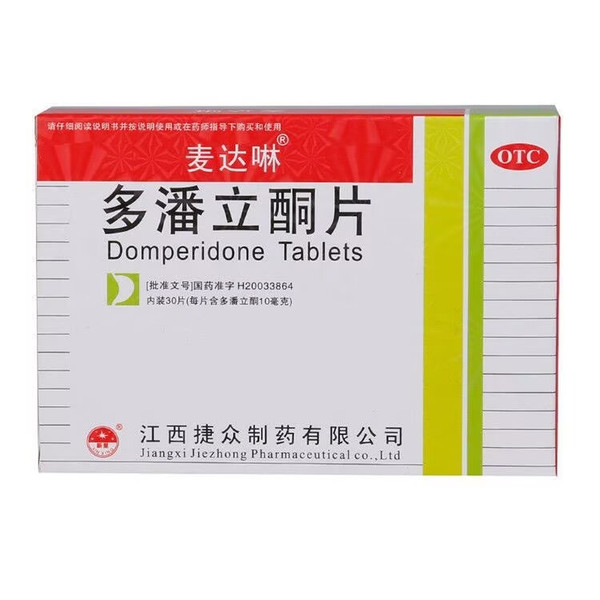
Generic Name: Domperidone Tablets
Trade Name: Madalin Domperidone Tablets 10mg x 30 Tablets
Pinyin Full Code: DuoPanLiTongPian
[Main Ingredients]
Active ingredient: Domperidone.
[Properties]
This product is a white tablet.
[Indications/Main Functions]
1. Dyspepsia caused by delayed gastric emptying, gastroesophageal reflux, and esophagitis.
2. Nausea and vomiting caused by functional, organic, infectious, dietary, radiotherapy, or chemotherapy. This product is specifically indicated for the treatment of nausea and vomiting caused by Parkinson's disease with dopamine receptor agonists (such as levodopa and bromocriptine).
[Specifications]
10mg x 30 tablets (Madalin)
[Dosage and Administration]
Oral. Adults: One tablet 3-4 times daily. The dose may be doubled if necessary or as directed by a physician. Children (over 12 years old and weighing over 35 kg): 0.3 mg per kilogram of body weight 3-4 times daily.
[Adverse Reactions]
1. Occasionally, transient, mild abdominal cramping may occur.
2. Serum prolactin levels may sometimes increase, but return to normal after discontinuation of the drug. This effect is similar to that seen with many other drugs.
[Contraindications]
1. This product is contraindicated in patients with allergies.
2. This product is contraindicated in patients with pheochromocytoma, breast cancer, mechanical intestinal obstruction, gastrointestinal bleeding, etc.
[Precautions]
1. This product is contraindicated in patients with allergies.
2. This product is contraindicated in patients with pheochromocytoma, breast cancer, mechanical intestinal obstruction, gastrointestinal bleeding, etc.
3. Domperidone suspension is recommended for children.
4. Use with caution in pregnant women.
5. Caution should be exercised in patients with heart disease (arrhythmias) and cancer patients undergoing chemotherapy, as this may aggravate arrhythmias.
6. If overdose or serious adverse reactions occur, seek medical attention immediately.
7. Do not use if the drug's properties change.
8. Keep this drug out of reach of children.
[Drug Interactions]
Anticholinergic drugs may antagonize the anti-dyspeptic effect of this drug; therefore, these drugs should not be used together.
[Pediatric Use]
Rare neurological side effects in infants and young children. Because infants' metabolism and cell barrier function are not fully developed in the first few months of life, the incidence of neurological side effects is higher than in children. Therefore, it is recommended that the dosage be accurately determined and strictly followed for newborns, infants, and young children. Overdose may cause neurological side effects, but other causes should also be considered.
[Elderly Use]
Geriatric use is the same as for adults.
[Pregnant and Breastfeeding Use]
Pregnancy: Experience with this drug in pregnant women is limited. Its potential harm to humans is unknown. However, in a study conducted in rats, domperidone exhibited reproductive toxicity at doses higher than those that were maternally toxic (40 times the recommended human dose). Therefore, this drug should be used with caution in pregnant women only after weighing the risks and benefits. During lactation, domperidone concentrations in breast milk range from 10% to 50% of the corresponding plasma concentration, but do not exceed 10 ng/mL. When breastfeeding women take the maximum recommended dose of this drug, the total amount of domperidone in breast milk is less than 7 μg/day, and it is unknown whether this drug poses a risk to the newborn. Therefore, breastfeeding is advised not to occur while taking this drug.
[Overdose]
Overdose has primarily been reported in infants and children. Symptoms of overdose include excitement, altered consciousness, seizures, disorientation, drowsiness, and extrapyramidal effects. There is no specific rescue medication for this drug. In the event of overdose, gastric lavage and administration of activated charcoal may be helpful. Close clinical monitoring and supportive care are recommended. Anticholinergic or anti-Parkinson's drugs may be helpful in controlling extrapyramidal reactions.
[Pharmacology and Toxicology]
1. Pharmacological Action: This drug is a peripheral dopamine receptor blocker that acts directly on the gastrointestinal wall. It increases lower esophageal sphincter tone, prevents gastroesophageal reflux, enhances gastric motility, promotes double emptying, coordinates gastric and duodenal motility, inhibits nausea and vomiting, and effectively prevents bile reflux without affecting gastric secretion. This drug does not readily cross the blood-brain barrier. Animal studies have shown that domperidone concentrations in the brain are very low and that it has a strong effect on peripheral dopamine receptors. Extrapyramidal reactions are rare in users (especially adults), but domperidone does stimulate the release of pituitary prolactin. Its antiemetic effect is primarily due to its dual blocking effect on both peripheral dopamine receptors and dopamine receptors in the chemoreceptor trigger zone beyond the blood-brain barrier. 2. Toxicology Studies: In a rat study, domperidone exhibited reproductive toxicity at doses higher than those found to be maternally toxic (40 times the recommended human dose). However, this effect was not observed in studies in mice and rabbits. In in vitro and in vivo electrophysiological studies, domperidone may prolong the QTc interval at high concentrations.
[Pharmacokinetics]
This drug is rapidly absorbed after oral administration on an empty stomach, reaching peak plasma concentrations in 30-60 minutes. Decreased gastric acidity can impair domperidone absorption. Domperidone is 91-93% protein-bound. Following a single oral dose in healthy volunteers, the plasma half-life is 7-9 hours, with a prolonged half-life in patients with severe renal impairment. This drug is metabolized almost entirely in the liver. In vitro metabolism studies using diagnostic inhibitors demonstrated that CYP3A4 is the primary cytochrome P-450 mechanism involved in N-dealkylation of domperidone, while CYP3A4, CYP1A2, and CYP2E1 are involved in aromatic hydroxylation of domperidone. Urinary excretion is 31%, with unchanged drug accounting for 1%. Fecal excretion is 66%, with unchanged drug accounting for 10%.
[Storage]
Sealed.
[Packaging]
10 mg x 30 seconds/box.
[Expiry Date]
24 months
[Approval Number]
National Medicine Standard H20033864
[Manufacturer]
Jiangxi Jiezhong Pharmaceutical Co., Ltd.


