
Product Overview
[Drug Name]
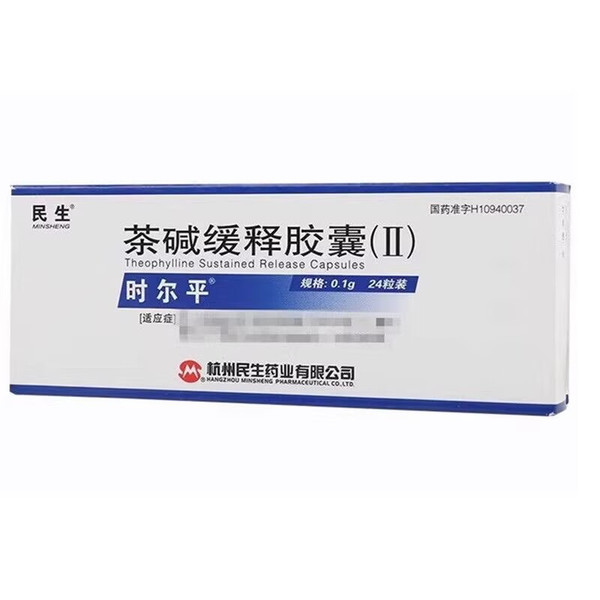
Generic Name: Theophylline Sustained-Release Capsules (II)
Trade Name: Shierping
English Name: THEOPHYLLINE SUSTAINED RELEASE CAPSULES (II)
Chinese Pinyin: Chajian Kongxi Jiaonang
[Ingredients]
Ingredients: Theophylline, chemical name: 1,3-dimethyl-3,7-dihydro-1H-purine-2,6-dione monohydrate.
[Properties]
This product is a capsule containing white spherical pellets.
[Indications]
1. Used to relieve or prevent chronic bronchial asthma or status asthmaticus in adults of all ages and children over 3 years old. Maintenance treatment after status asthmaticus can effectively prevent recurrence. Combination with a β2-receptor agonist or glucocorticoid offers greater efficacy than either drug alone, with fewer side effects and better tolerability.
2. Also indicated for the treatment of reversible bronchospasm associated with chronic bronchitis and emphysema.
3. It ensures a normal life for patients with chronic obstructive pulmonary disease (COPD) during the winter, and is particularly suitable for those with nocturnal asthma attacks.
[Dosage and Administration]
Swallow the capsule whole, or dissolve the small pellet in half a tablespoon of warm water or liquid food. Adults: 0.2-0.3g once every 12 hours; children over 1 year old: 0.1-0.2g once every 12 hours (children 1-9 years: 0.1g once every 12 hours; children 9-12 years: 0.2g once every 12-16 years old).
[Adverse Reactions]
Adverse reactions are related to the individual's rate of theophylline clearance. Toxicity typically occurs at serum concentrations of 15-20 μg/mL. In a few patients, when theophylline blood concentrations exceed 20 μg/mL, headache, nausea, vomiting, and insomnia are common. Less common symptoms include indigestion, tremor, and dizziness. Symptoms are generally mild to moderate, and severe reactions are rare. When the blood concentration exceeds 40 μg/ml, fever, dehydration, convulsions, and even respiratory and cardiac arrest may occur in severe cases.
[Contraindications]
This product is contraindicated in patients who cannot tolerate theophylline, patients with unresolved underlying epilepsy, and those with acute myocardial infarction and hypotension.
[Precautions]
1. Do not chew or swallow. Do not exceed the prescribed dose.
2. This product is not suitable for patients experiencing an asthma attack or acute bronchospasm.
3. Theophylline can cause arrhythmias and may worsen existing arrhythmias. Patients with abnormal heart rhythms or any significant changes in heart rhythm should be monitored and investigated.
4. Use with caution in patients with peptic ulcers, hepatic and renal insufficiency, liver disease, heart failure of any cause, persistent high fever, those taking certain medications, hypoxemia, or hypertension. Serum theophylline concentrations should be monitored carefully.
[Use in Special Populations]
Precautions for Children:
Drug elimination rates are higher in children, and higher doses are required to achieve effective blood concentrations. Blood concentrations should be monitored during use. Precautions during pregnancy and lactation:
Pregnant and lactating women should avoid the use of theophylline preparations.
Precautions for the elderly:
Elderly patients may have different elimination rates of theophylline, so blood levels should be monitored and maintained between 7.5 and 12.5 mg/mL.
[Drug Interactions]
1. Theophylline can be toxic when used with ephedrine, as can other sympathomimetic amine bronchodilators.
2. Theophylline can be increased in serum when used with allopurinol (high doses), cimetidine, and oral contraceptives.
3. Theophylline can be decreased in serum when used with rifampicin, phenobarbital, aminoglutethimide, pentobarbital, and isoproterenol (intravenous injection). When used with phenytoin, theophylline can also decrease blood levels of both drugs.
4. For patients who require theophylline, it is best to avoid the use of non-selective beta-blockers, as their pharmacological effects antagonize each other.
5. When used in combination with clindamycin, lincomycin, certain macrolides (erythromycin, roxithromycin, clarithromycin), and quinolone antibiotics (enoxacin, ciprofloxacin), the hepatic metabolism of this drug may be reduced, leading to increased blood concentrations and even toxicity. Therefore, the dosage of this drug should be adjusted before and after administration.
6. When used in combination with lithium salts, the renal excretion of lithium may be accelerated, reducing the efficacy of the latter.
7. Smokers have increased hepatic metabolism of theophylline, requiring an increased dosage.
[Pharmacological Actions]
Theophylline directly relaxes bronchial smooth muscle, particularly in bronchi that are contracted and spasmodic. It also inhibits histamine release from mast cells and basophils, exerting anti-inflammatory effects. It can strengthen diaphragmatic contractility and reduce fatigability, thereby improving diaphragmatic contractility in patients with chronic obstructive pulmonary disease (COPD). Theophylline also enhances myocardial contractility and has a mild diuretic effect.
[Storage]
Store in a dark, airtight container.
[Specification]
0.1g
[Packaging]
Aluminum-plastic packaging, 24 tablets per box
[Expiry Date]
24 months
[Approval Number]
National Medicine Standard H10940037
[Manufacturer]
Company Name: Hangzhou Minsheng Pharmaceutical Co., Ltd.


