Product Overview
[Drug Name]
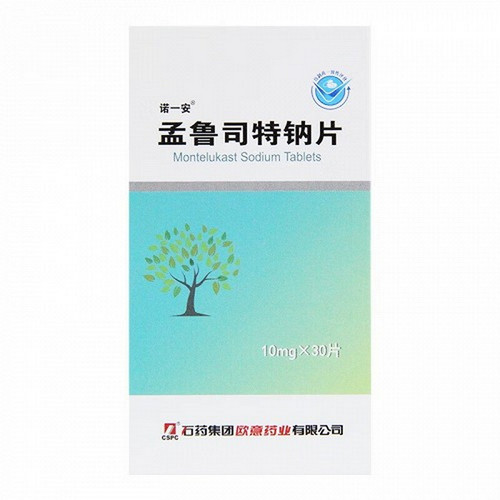
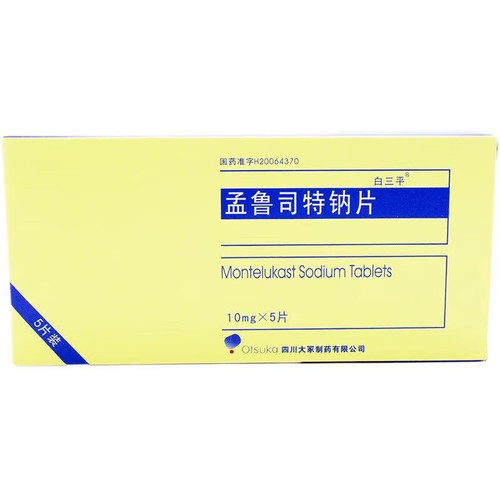
Generic Name: Montelukast Sodium Tablets
Trade Name: Shanxiaoshu Montelukast Sodium Tablets 10mg x 30 Tablets
[Main Ingredient]
The main ingredient of this product is montelukast sodium. Chemical Name: [R-(①}-[1-3-1,2-7-Oxy-2-quinolinyl)vinylphenyl]-3-{2-(1-methyl-1-ethylethyl)phenyl]propyl]thiomethyl]cyclopropaneacetic acid sodium. Molecular Formula: C35H35CNNaO3S. Molecular Weight: 608.18
[Properties]
This product is a beige, round, biconvex film-coated tablet with "SZ344" debossed on one side and a flat surface on the other side. After removal of the coating, the tablet appears natural or off-white.
[Indications/Main Functions]
This product is indicated for the prevention and long-term treatment of asthma in adults aged 15 years and older, including the prevention of daytime and nighttime asthma symptoms, the treatment of aspirin-sensitive asthma, and the prevention of exercise-induced bronchoconstriction. This product is indicated for the relief of symptoms caused by allergic rhinitis (seasonal and perennial allergic rhinitis in adults 15 years and older).
[Specifications]
10mg x 30 tablets
[Dosage and Administration]
Take one tablet (10mg) once daily. Asthma patients should take the tablet at bedtime. Allergic rhinitis patients may take the tablet as needed based on their condition. Patients with both asthma and allergic rhinitis should take the tablet once nightly. Adults 15 years and older with asthma and/or allergic rhinitis should take the tablet once daily, 10mg each time. Asthma control indicators are generally recommended as the evaluation of treatment efficacy. The efficacy of this product is apparent within one day of treatment. This product can be taken with or without food. Patients should be advised to continue taking the tablet regardless of whether their asthma is under control or exacerbated. No dosage adjustment is required for elderly patients, those with renal insufficiency, those with mild to moderate hepatic impairment, or patients of different genders. Montelukast sodium tablets and their interactions with other asthma medications: This product can be added to a patient's existing treatment regimen. Reduce the dose of concomitant medications: For patients whose asthma is not effectively controlled with bronchodilators alone, this product can be added to the treatment regimen. Once a clear clinical response is observed (generally after the first dose), the bronchodilator dose can be reduced based on the patient's tolerance. For patients with asthma receiving inhaled corticosteroids, the dose of the corticosteroid can be appropriately reduced based on the patient's tolerance. The dose should be gradually reduced under the guidance of a physician, and some patients can gradually reduce the dose until inhaled corticosteroids are completely discontinued. However, this product should not be used abruptly to replace inhaled corticosteroids.
[Adverse Reactions]
This product is generally well tolerated, with mild adverse reactions that generally do not require discontinuation of treatment. The overall incidence of adverse reactions with this product is similar to that with placebo. The safety of the original montelukast sodium tablets has been evaluated in a clinical study of approximately 2,600 adult patients with asthma aged 15 years and older. In two similarly designed, placebo-controlled, 12-week clinical studies, abdominal pain and headache were the only drug-related adverse events observed in the brand-name montelukast sodium tablets group with an incidence greater than or equal to 1% and greater than that observed in the placebo group. However, the incidence of these adverse events did not differ significantly between the two groups. In clinical studies, a total of 544 patients were treated with the brand-name montelukast sodium tablets for at least 6 months, 253 patients for 1 year, and 21 patients for 2 years. The adverse event profile did not change with extended treatment duration with the brand-name montelukast sodium tablets. The safety of the brand-name montelukast sodium tablets was evaluated in a clinical study of 2,199 adult patients aged 15 years and older with seasonal allergic rhinitis. The brand-name montelukast sodium tablets, taken once daily in the morning or evening, were well tolerated, with an adverse reaction rate similar to that observed with placebo. In the placebo-controlled clinical studies, no drug-related adverse events were observed in the brand-name montelukast sodium tablets group with an incidence greater than 1% or greater than that observed in the placebo group. In the four-week, placebo-controlled clinical studies, the safety profile was consistent with that in the two-week studies. Across all clinical studies, the incidence of somnolence was similar to that in the placebo group. The safety profile of the original montelukast sodium tablets was evaluated in two six-week, placebo-controlled clinical studies in 3,235 adult patients aged 15 years and older with perennial allergic rhinitis. Once-daily administration of the original montelukast sodium tablets was well tolerated, with an adverse reaction rate similar to that in the placebo group and consistent with clinical studies in seasonal allergic rhinitis. In both clinical studies, the incidence of adverse events in the treatment groups was less than 1%, none of which was found to be drug-related, and the incidence was higher than that in the placebo group. The incidence of somnolence was similar to that in the placebo group. A pooled analysis of clinical practice included 41 placebo-controlled clinical studies (35 studies in patients aged 15 years and older; 6 studies in children aged 6-14 years) using a validated suicidal behavior assessment method. Among 9929 patients taking brand-name montelukast sodium tablets and 7780 taking placebo, one patient with suicidal ideation took brand-name montelukast sodium tablets. Completed suicides, suicide attempts, or preparatory actions toward suicidal behavior were not reported in either group. A separate pooled analysis of 46 placebo-controlled clinical studies (35 studies in patients 15 years of age and older; 11 studies in pediatric patients 3 months to 14 years of age) evaluated behavior-related adverse events. Among 11,673 patients taking brand-name montelukast sodium tablets and 8827 patients taking placebo, the incidence of behavior-related adverse events was 2.73% and 2.27%, respectively; the odds ratio was 1.12 (95% CI 0.93 to 1.36). The clinical trials included in this pooled analysis were not specifically designed to examine suicide rates or behavior-related adverse events. Postmarketing Experience: The following adverse reactions have been reported with brand-name montelukast sodium tablets postmarketing: Infections and infections: Upper respiratory tract infection. Hematologic and Lymphatic System Disorders: Increased bleeding tendency, thrombocytopenia. Immune System Disorders: Hypersensitivity reactions, including allergic reactions, and very rare hepatic infiltration with eosinophils. Psychiatric Disorders: Aggressive behavior or hostile excitement, anxiety, depression, disorientation, difficulty concentrating, abnormal dreams, stuttering, hallucinations, insomnia, memory impairment, obsessive-compulsive symptoms, psychomotor agitation (including irritability, restlessness, and tremors), sleepwalking, suicidal thoughts and behaviors (suicide), and convulsions.Nervous System Disorders: Dizziness, somnolence, paresthesia/hypoesthesia, and very rare epileptic seizures. Cardiac Disorders: Palpitations. Respiratory, Thoracic, and Mediastinal System Disorders: Epistaxis; pulmonary eosinophilia. Gastrointestinal Disorders: Diarrhea, dyspepsia, nausea, pancreatitis, and vomiting. Hepatobiliary Disorders: Elevated ALT and AST levels, and very rare hepatitis (including cholestatic, hepatocellular, and mixed forms). Skin and Subcutaneous Tissue Disorders: Angioedema, contusions, erythema multiforme, erythema nodosum, pruritus, rash, Stevens-Johnson syndrome/toxic epidermal necrolysis, urticaria. Musculoskeletal and Connective Tissue Disorders: Arthralgia, myalgia including muscle cramps. Renal and Urinary Disorders: Enuresis in children (occasionally). Other Disorders and Administration Site Conditions: Asthenia/fatigue, edema, fever.
[Contraindications]
This product is contraindicated in patients with hypersensitivity to any of the ingredients.
[Precautions]
The oral efficacy of this product for the treatment of acute asthma attacks has not been established. Therefore, it should not be used to treat acute asthma attacks. Patients should be advised to have appropriate rescue medications available. Although the dose of concomitant inhaled corticosteroids can be gradually reduced under the guidance of a physician, this product should not be used abruptly to replace inhaled or oral corticosteroids. Rarely, patients receiving antiasthma medications, including leukotriene receptor antagonists, have experienced one or more of the following: eosinophilia, vascular rash, worsening pulmonary symptoms, cardiac complications, and/or neuropathy (sometimes diagnosed as Churg-Straus syndrome, a systemic eosinophilic vasculitis). These events have sometimes been associated with reduction or discontinuation of oral glucocorticoid therapy. Although a causal relationship between these events and leukotriene receptor antagonists has not been established, caution and appropriate clinical monitoring are recommended for patients taking this medication. This medication should not be used by patients with rare hereditary conditions such as galactose intolerance, lactase deficiency, or glucose-galactose malabsorption. Montelukast may have little or no effect on the ability to drive or operate machinery. However, there have been isolated reports of drowsiness and dizziness. Neuropsychiatric events have been reported in adults, adolescents, and children taking the original montelukast sodium tablets. Postmarketing reports of patients taking the brand-name montelukast sodium tablets include excitement, aggressive behavior or hostility, anxiety, depression, disorientation, attention deficit disorder, abnormal dreams, stuttering (stammering), hallucinations, insomnia, irritability, memory impairment, obsessive-compulsive symptoms, restlessness, sleepwalking, suicidal thoughts and behaviors (including suicide), convulsions, and tremors. Clinical details in some postmarketing reports of brand-name montelukast sodium tablets appear consistent with drug-induced effects. Psychoneural events have been reported in patients taking brand-name montelukast sodium tablets (see Adverse Reactions). Because other factors may contribute to these events, a relationship to brand-name montelukast sodium tablets cannot be confirmed. Physicians should discuss these adverse events with patients and/or caregivers. Patients and/or caregivers should be advised to notify their physician if these events occur. Patients with known aspirin sensitivity should continue to avoid aspirin or nonsteroidal anti-inflammatory drugs while taking this product.