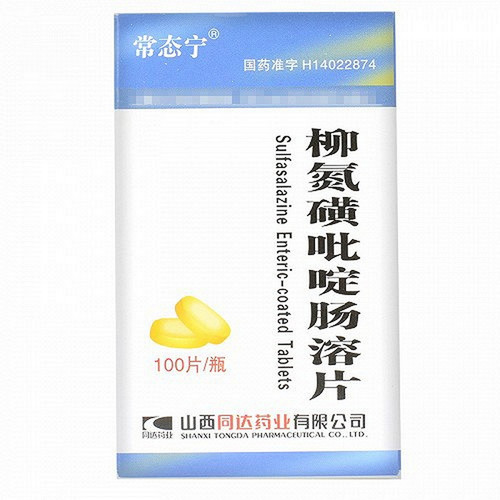
Product Overview
[Trade Name]
Sulfasalazine Enteric-Coated Tablets
[Generic Name]
Sulfasalazine Enteric-Coated Tablets
[Main Ingredients]
The main ingredient of this product is sulfasalazine.
[Indications]
1. Ulcerative Colitis: Treatment of mild to moderate ulcerative colitis; can be used as an adjunctive therapy for severe ulcerative colitis. It can also be used for maintenance treatment of ulcerative colitis during remission.
2. Crohn's Disease: Treatment of active Crohn's disease, particularly those with colitis.
3. Rheumatoid Arthritis: Rheumatoid arthritis and juvenile rheumatoid arthritis (polyarticular type) that are ineffective with salicylates or other nonsteroidal anti-inflammatory drugs.
[Adverse Reactions]
1. The most common adverse reactions include: nausea, anorexia, fever, erythema and itching, headache, and palpitations.
2. The following adverse reactions are rare and may be dose-related: Hematologic reactions: Red blood cell abnormalities (e.g., hemolytic anemia, macrocytosis), cyanosis. Gastrointestinal reactions: Stomach and abdominal pain. Central nervous system reactions: Dizziness, tinnitus. Renal reactions: Proteinuria, hematuria. Skin reactions: Yellowing of the skin.
3. The following reactions may not be dose-related. Hematologic reactions: Myelosuppression, such as with leukopenia, granulocytopenia, and thrombocytopenia. Gastrointestinal reactions: Hepatitis, pancreatitis. Central nervous system reactions: Peripheral neuropathy, aseptic meningitis. Skin reactions: Rash, urticaria, erythema multiforme/Stevens-Johnson syndrome, exfoliative dermatitis, epidermal necrolysis syndrome, photosensitivity. Pulmonary reactions: Pulmonary complications (fibrosing alveolitis with symptoms such as dyspnea, cough, fever, and eosinophilia). Other hypersensitivity reactions: Periorbital edema, serum sickness, Leukemia syndrome, and nephrotic syndrome. Male reproductive dysfunction: There have been reports of males treated with sulfasalazine experiencing azoospermia and infertility. This reaction can be reversed by discontinuing the drug.
[Contraindications]
This product is contraindicated in patients allergic to sulfonamides, pregnant or lactating women, and children under two years of age.
[Precautions]
1. Use with caution in patients with glucose-6-phosphate dehydrogenase deficiency, liver or renal impairment, porphyria, thrombocytopenia, granulocytopenia, porphyria, or intestinal or urinary tract obstruction.
2. During sulfonamide treatment, drink plenty of fluids and maintain a high urine flow to prevent crystalluria. Urine alkalinization medications may be used if necessary. For long-term, high-dose treatment with this product, sodium bicarbonate should be taken with plenty of fluids to prevent this adverse reaction. During treatment, urinalysis should be performed at least two to three times weekly. If crystalluria or hematuria is detected, administer sodium bicarbonate and plenty of water until the crystalluria or hematuria disappears. This product can easily cause kidney damage in patients with dehydration, shock, or the elderly. It should be used with caution or avoided.
3. Patients who are allergic to furosemide, sulfones, thiazide diuretics, sulfonylureas, carbonic anhydrase inhibitors, and other sulfonamides may also be allergic to this product.
4. During treatment, the following items should be carefully checked:
(1) Complete blood count, which is especially important for patients receiving longer courses of treatment.
(2) Proctoscopy and sigmoidoscopy to observe the effect of medication and adjust the dosage.
(3) Regular urine tests during treatment (urinalysis every 2 to 3 days) to detect crystalluria that may occur during long-term or high-dose treatment.
(4) Liver and kidney function tests.
(5) In case of gastrointestinal irritation symptoms, in addition to emphasizing taking the medicine after meals, it can also be taken in small doses multiple times, or even once every hour, to alleviate the symptoms. (6) Adjust the dose at any time according to the patient's response and drug tolerance. Some patients can use intermittent treatment (two weeks of medication and one week of rest).
(7) If diarrhea symptoms do not improve, the dose can be increased.
(8) The interval between nocturnal medication should not exceed 8 hours.
(9) The dose should be reduced for patients with renal impairment.
[Use in pregnant and lactating women]
1. Sulfonamides can cross the blood-placental barrier and reach the fetus. Animal experiments have found that they have teratogenic effects. There is a lack of sufficient data on human studies, so pregnant women should not use them.
2. Sulfonamides can be secreted in breast milk, and the concentration in breast milk can reach about 50% to 100% of the maternal blood drug concentration. The drug may affect the infant; the use of sulfonamides in newborns with glucose-6-phosphate dehydrogenase deficiency may cause hemolytic anemia. Therefore, lactating women should not use them.
[Children's Use]
Because sulfonamides can compete with bilirubin for binding sites on plasma proteins, and because the acetyltransferase system in newborns is not fully developed, the free blood concentration of sulfonamides increases, increasing the risk of kernicterus. Therefore, these drugs should be contraindicated in newborns and children under two years of age.
[Elderly Use]
Elderly patients are more likely to experience serious adverse reactions from sulfonamides. Severe rash, bone marrow suppression, and thrombocytopenia are common serious adverse reactions in the elderly. Therefore, their use should be avoided in elderly patients. When indicated, the decision should be made after weighing the risks and benefits.
[Drug Interactions]
1. Concomitant use with urinary alkalinizing agents can increase the solubility of sulfonamides in alkaline urine, leading to increased excretion.
2. Para-aminobenzoic acid can replace sulfonamides in bacterial uptake, antagonizing the antibacterial effects of sulfonamides. Therefore, the two drugs should not be used together. 3. When the following drugs are used concomitantly with sulfonamides, the latter may displace these drugs' protein binding sites or inhibit their metabolism, resulting in prolonged drug action or toxicity. Therefore, dose adjustment is required when these drugs are used concomitantly with sulfonamides or after sulfonamides. These drugs include oral anticoagulants, oral hypoglycemics, methotrexate, phenytoin sodium, and thiopental sodium.
4. Myelosuppressive drugs may enhance the adverse effects of sulfonamides on the hematopoietic system when used concomitantly with these drugs. If combined use of these two classes of drugs is indicated, close observation for possible toxic reactions is advised.
5. Concomitant use of contraceptives (estrogens) with sulfonamides for a long time may reduce contraceptive reliability and increase the risk of extramenstrual bleeding.
6. Concomitant use of thrombolytics with sulfonamides may enhance their potential toxic effects.
7. Concomitant use of hepatotoxic drugs with sulfonamides may increase the incidence of hepatotoxicity. Liver function should be monitored in patients with these conditions, especially those taking these drugs for a long time and those with a history of liver disease. 8. Concomitant use of photosensitizing drugs and sulfonamides may result in additive photosensitivity.
9. Patients receiving sulfonamide therapy have an increased requirement for vitamin K.
10. Hexamethylenetetramine decomposes in acidic urine to produce formaldehyde, which can form an insoluble precipitate with sulfonamides. This increases the risk of crystalluria, so the two drugs should not be used together.
11. Sulfonamides can displace the plasma protein binding sites of phenylbutazone, and their combined use can enhance the effects of phenylbutazone.
12. Concomitant use of sulfinpyrazone with sulfonamides can reduce the latter's renal tubular secretion, resulting in elevated and prolonged blood concentrations and potentially toxic effects. Therefore, the sulfonamide dose may need to be adjusted during or after sulfinpyrazone treatment. When sulfinpyrazone treatment is prolonged, blood sulfonamide concentrations should be monitored to facilitate dosage adjustments and ensure safe use. 13. When used concomitantly with digitalis or folic acid, the latter's absorption is reduced, leading to lower blood concentrations. Therefore, the effects and efficacy of digitalis must be monitored at all times.
14. Concomitant use with probenecid can reduce renal tubular sulfonamide excretion, leading to increased blood sulfonamide concentrations, prolonged effects, and increased toxicity.
15. When used concomitantly with neomycin, neomycin inhibits intestinal flora, affecting the intestinal breakdown of this drug and reducing its effectiveness.
[Overdose]
When the daily dose reaches or exceeds 4g or the serum drug concentration exceeds 50mg/ml, adverse reactions or toxic reactions may increase.
[Toxicology]
Relevant experiments have not been conducted and no reference data are available.
[Pharmacokinetics]
After oral administration, a small portion of the drug is absorbed in the gastrointestinal tract and re-enters the intestine via bile (enterohepatic circulation). The unabsorbed portion is broken down by bacteria in the terminal ileum and colon into 5-aminosalicylic acid and sulfapyridine, with the remainder excreted in the feces. 5-Aminosalicylic acid is largely unabsorbed and excreted unchanged in the feces. However, its N-acetyl derivative can be detected in urine. Sulfapyridine is absorbed and excreted, and its acetylated metabolites can be detected in urine. Sulfapyridine and its metabolites can also be found in breast milk.
[Storage]
Store in a tightly closed container away from light.