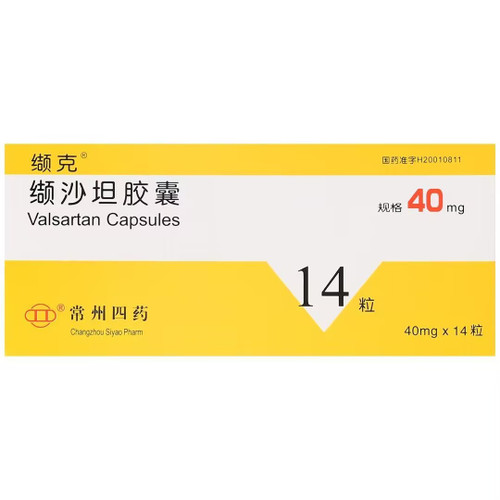
Product Overview
[Drug Name]
Generic Name: Pinsartan Tablets
Trade Name: Valc Pinsartan Tablets 40mg*30 Tablets
Pinyin Code: ZuoKe ZuoShaTanPian 40mg*30 Tablets
[Main Ingredient]
The main ingredient of this product is pinsartan. Chemical Name: (S)-N-Valeryl-N-{[2'-(1H-5-tetrazolyl)-4-diphenyl]methyl}-valine. Molecular Formula: C24H29N5O3. Molecular Weight: 435.52
[Properties]
This product is a yellow film-coated tablet with a score. After removal of the coating, it appears off-white or white.
[Indications/Main Functions]
Treatment of mild to moderate essential hypertension.
[Specifications]
40mg*30 tablets
[Dosage and Administration]
Recommended dose: 80mg or 160mg once daily. Dosage is not affected by race, age, or gender. It can be taken with or without food (see [Pharmacokinetics]). It is recommended to take the drug at the same time each day (e.g., morning). A definitive antihypertensive effect is achieved within 2 weeks of treatment, and maximal efficacy is achieved after 4 weeks. If the antihypertensive effect is unsatisfactory, a diuretic may be added. Elderly individuals generally do not require initial dose adjustment. Patients with mild to moderate renal impairment do not require initial dose adjustment. For severe renal impairment (creatinine clearance <30 m/min), see [Contraindications]. Patients with mild to moderate hepatic impairment of non-biliary origin and without cholestasis do not require dose adjustment. No dose is recommended for patients with severe hepatic impairment. Patients with impaired liver or kidney function require increased monitoring when using this drug. Pinsartan can be used in combination with other antihypertensive drugs.
[Adverse Reactions]
See the package insert for details.
[Contraindications]
Allergy to pinsartan or any of the other excipients in this drug. Pregnancy (see [Use in Pregnant and Lactating Women]). There are currently no data on its use in patients with severe renal impairment (creatinine clearance <30 mI/min). Do not use this drug concomitantly with aliskiren in patients with diabetes.
[Precautions]
Fetus and Neonate: Use of drugs that directly act on the renin-angiotensin system during the second and third trimesters of pregnancy may impair renal function in the fetus and increase the risk of morbidity and mortality in the fetus and neonate. Oligohydramnios, pulmonary hypoplasia, and skeletal malformations may result. Potential neonatal adverse reactions include: craniosynostosis, anuria, hypotension, renal failure, and death. Immediately discontinue this drug upon detection of pregnancy. Hyponatremia and/or Hypovolemia: Rarely, patients with severe sodium and/or hypovolemia (e.g., those taking high-dose diuretics) may experience symptomatic hypotension when starting treatment with this drug. Hyponatremia and/or hypovolemia should be corrected before starting treatment, for example, by reducing the diuretic dose. If hypotension occurs, the patient should be placed in a supine position and given intravenous saline as needed. Treatment with this drug can be continued after blood pressure stabilizes. Renal Artery Stenosis: Short-term use of this drug for 4 days in 12 patients with secondary renovascular hypertension due to unilateral renal artery stenosis did not cause significant changes in renal hemodynamics, creatinine, or blood urea nitrogen (BUN). Because other drugs that act on the renin-angiotensin-aldosterone system (RAAS) may increase BUN and creatinine in patients with unilateral or bilateral renal artery stenosis, monitoring BUN and creatinine is recommended as a safety measure. Renal Impairment: No initial dose adjustment is required for patients with mild to moderate renal impairment. Patients with renal impairment require increased monitoring when using this drug. There are no data on the use of this drug in patients with severe renal impairment (creatinine clearance <30 mI/min), and its use is not recommended (see [Contraindications]). This drug should not be used concomitantly with aliskiren in patients with diabetes. Avoid concomitant use of this drug with aliskiren in patients with renal impairment (creatinine clearance <60 mI/min). Due to inhibition of the renin-angiotensin-aldosterone system (RAAS), susceptible individuals may experience altered renal function. Patients whose renal function may be partially dependent on RAAS activity (e.g., renal artery stenosis, chronic renal impairment, severe congestive heart failure, or volume depletion) are at increased risk of acute renal impairment (including acute renal failure) when using drugs that inhibit RAAS (including valsartan). Renal function should be monitored regularly in such susceptible patients when using this drug. Hepatic Impairment: No dose adjustment is required for patients with mild to moderate hepatic impairment of non-biliary origin and without cholestasis. Valsartan is excreted primarily unchanged in the bile, with reduced excretion in patients with biliary obstruction (see Pharmacokinetics). This drug should be used with caution in patients with biliary obstruction and cholestasis. No dosage is recommended for patients with severe hepatic impairment. Patients with hepatic impairment require increased monitoring when using this drug. Angioedema: Angioedema, including laryngeal and glottic edema, leading to airway obstruction and/or swelling of the face, lips, pharynx, and/or tongue, has been reported in patients treated with valsartan; some of these patients have a history of angioedema with other medications, including ACE inhibitors. Valsartan should be discontinued immediately in patients who develop angioedema and should not be re-administered. Dual Blockade of the Renin-Angiotensin-Aldosterone System: Extreme caution should be exercised when coadministering angiotensin receptor blockers (including valsartan) with ACE inhibitors or aliskiren. Blood pressure, renal function, and electrolytes should be closely monitored when valsartan is used concomitantly with other drugs that block the renin-angiotensin-aldosterone system.