Product Overview
[Drug Name]
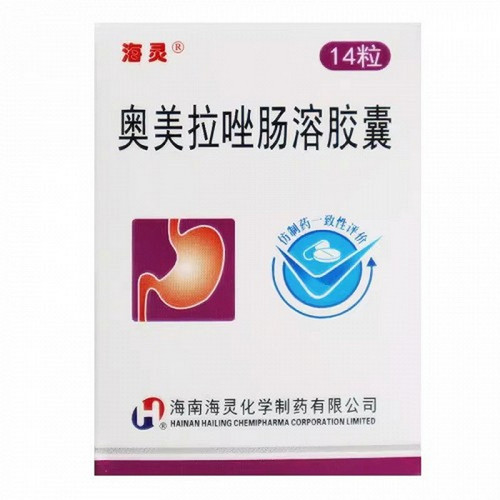
Generic Name: Omeprazole Enteric-Coated Capsules
Trade Name: Yatai Omeprazole Enteric-Coated Capsules 20mg*14 Capsules
Pinyin Full Code: YaTai AoMeiLaZuoChangRongJiaoNang 20mg*14Li
[Main Ingredient]
Omeprazole.
[Properties]
This product is a capsule containing small granules in an off-white enteric coating.
[Indications/Main Functions]
Indicated for gastric ulcers, duodenal ulcers, stress ulcers, reflux esophagitis, and Zollinger-Ellison syndrome (gastrinoma).
[Specifications]
20mg*14 Capsules
[Dosage and Administration]
Oral administration, do not chew. 1. Peptic ulcer: 20mg (1 tablet) once or twice daily. Take orally once daily in the morning or in the evening. The treatment course for gastric ulcers is usually 4 to 8 weeks, and for duodenal ulcers is usually 2 to 4 weeks. 2. Reflux esophagitis: 20 to 60 mg (1 to 3 tablets) once or twice daily. Take orally once in the morning or in the evening. The treatment course is usually 4 to 8 weeks. 3. Zollinger-Ellison syndrome: 60 mg (3 tablets) once daily. The total daily dose can be adjusted to 20 to 120 mg (1 to 6 tablets) depending on the condition. If the total daily dose exceeds 80 mg (4 tablets), it should be taken in two divided doses.
[Adverse Reactions]
Omeprazole enteric-coated capsules are well tolerated. Common adverse reactions include diarrhea, headache, nausea, abdominal pain, flatulence, and constipation. Elevated serum aminotransferases (ALT, AST), rash, dizziness, drowsiness, and insomnia may occur occasionally. These adverse reactions are generally mild and resolve spontaneously. They are not dose-related. No serious adverse reactions have been observed with long-term treatment. However, in some cases, gastric leucocytosis and atrophic gastritis may occur.
[Contraindications]
This product is contraindicated in patients with allergies to this product, severe renal insufficiency, and infants and young children.
[Precautions]
1. When treating gastric ulcers, the possibility of ulcerative gastric cancer should be ruled out first, as this product may alleviate its symptoms and delay treatment.
2. Use with caution in patients with hepatic and renal insufficiency.
3. This product is an enteric-coated capsule. Be careful not to chew it when taking it to avoid premature release of the drug in the stomach, which could affect its efficacy.
[Drug Interactions]
This product may delay the elimination of drugs metabolized by the liver, such as diazepam, phenytoin, warfarin, and nifedipine. When used with these drugs, the dosage of the latter should be reduced.
[Use in Children]
There is no experience with this product in children, and its use in children is not recommended.
[Use in Elderly Patients]
The information is not yet available.
[Use During Pregnancy and Lactation]
Although animal studies have shown that this drug has no fetotoxic or teratogenic effects, it is generally not used in pregnant women and should be used with caution in lactating women.
[Overdose]
Not yet known.
[Pharmacology and Toxicology]
Proton pump inhibitor. This drug is a lipid-soluble, weakly alkaline drug that is easily concentrated in acidic environments. Therefore, after oral administration of omeprazole enteric-coated capsules, it is specifically distributed in the secretory tubules of the gastric mucosal parietal cells. In this highly acidic environment, it is converted to its active form, the sulfenamide. It then irreversibly binds to the sulfhydryl group of the H+,K+-ATPase (also known as the proton pump) in the parietal cell secretory membrane via a disulfide bond, forming a sulfenamide-proton pump complex, thereby inhibiting the enzyme's activity and blocking the final step in gastric acid secretion. Therefore, this drug has a strong and long-lasting inhibitory effect on gastric acid secretion caused by various reasons.
[Pharmacokinetics]
After oral administration, this drug is absorbed through the small intestine, with onset of action within 1 hour, peak plasma concentrations reaching 0.5-3.5 hours, and duration of action exceeding 24 hours. It is distributed to tissues such as the liver, kidneys, stomach, duodenum, and thyroid gland, and readily crosses the placenta. Bioavailability is typically approximately 36% with a single dose, increasing to approximately 60% with multiple doses. Plasma protein binding is 85-95%, with a plasma half-life of 0.5-1 hour, and 3 hours in patients with chronic liver disease. This drug is metabolized in vivo by the hepatic microsomal cytochrome P450 oxidase system. 80% of the metabolites are excreted in the urine, with the remainder excreted in the bile and then in the feces.
[Storage]
Sealed.
[Packaging]
14 tablets per box.
[Expiry Date]
36 months
[Approval Number]
National Medicine Standard H20045555
[Manufacturer]
Zhejiang Asia Pacific Pharmaceutical Co., Ltd.