Product Overview
[Drug Name]
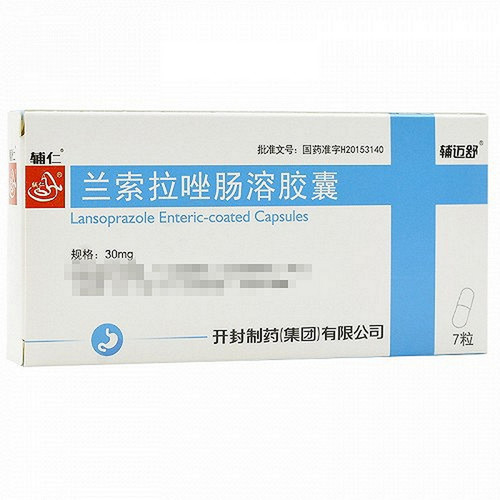
Generic Name: Lansoprazole Enteric-Coated Capsules
Trade Name: Xinye Lansoprazole Enteric-Coated Capsules 30mg*5 capsules
Pinyin Full Code: ZuoZuo LanSuoLaZuoChangRongJiaoNang 30mg*5Li
[Main Ingredient]
Lansoprazole.
[Properties]
This product is a white capsule containing white or off-white enteric-coated spherical granules.
[Indications/Main Functions]
Gastric ulcer, duodenal ulcer, reflux esophagitis, Zolliger-Elison syndrome, and anastomotic ulcers.
[Specifications]
30mg*5 tablets (Xinye)
[Dosage and Administration]
For duodenal ulcers, adults should generally take 15mg-30mg of lansoprazole orally once daily for 4-6 weeks. For gastric ulcers, reflux esophagitis, Zollinger-Elison syndrome, and anastomotic ulcers, adults should generally take 30mg of lansoprazole orally once daily for 6-8 weeks. However, for maintenance therapy, the elderly, and patients with liver or renal impairment, 15mg of lansoprazole can be taken orally once daily.
[Adverse Reactions]
1) Hypersensitivity: Occasionally, rash and itching may occur. Discontinue use if these symptoms occur. 2) Liver: Occasionally, elevated levels of GOT, GPT, AL-P, LDH, and n-GTP may occur. Careful observation is required. If any abnormalities are observed, appropriate measures should be taken, including discontinuation of the drug. 3) Hematology: Occasionally, symptoms such as anemia, leukopenia, and eosinophilia may occur; thrombocytopenia is rare. 4) Digestive System: Occasionally, symptoms such as constipation, diarrhea, thirst, and abdominal distension may occur. 5) Neuropsychiatric System: Occasionally, symptoms such as headache and drowsiness may occur. Insomnia and dizziness may rarely occur. 6) Other: Occasionally, symptoms such as fever, elevated total cholesterol, and elevated uric acid may occur.
[Contraindications]
This product is contraindicated in patients with a history of allergies to any of its ingredients. Furthermore, it should be used with caution in patients with a history of drug allergies, those with liver dysfunction, and pregnant and lactating women.
[Drug Interactions]
Lansoprazole Enteric-Coated Capsules are primarily metabolized by the hepatic drug-metabolizing enzymes CYP2C19 and CYP3A4. The gastric secretion inhibitory effect of lansoprazole enteric-coated capsules may promote or inhibit the absorption of concomitant medications.
[Precautions]
1. During treatment, patients should be closely monitored and the minimum dose required for treatment should be used according to their symptoms. 2. Use with caution in the following patients: 1) Patients with drug allergies; 2) Patients with functional impairments. 3. In a 52-week oral administration study in rats, one case of benign interstitial cell tumor was observed in the 50 mg/kg/day group (100 times the clinical dose). In a 24-month oral administration study in rats, the incidence of interstitial cell tumors was increased in the 15 mg and 50 mg/kg/day groups, and one case of gastric carcinoid was observed in a female rat in the 50 mg/kg/day group. Because this drug can mask the symptoms of gastric cancer, gastric cancer must be ruled out before administration.
[Pediatric Use]
The safety of this drug in children has not been established (clinical experience in pediatric patients is minimal).
[Elderly Use]
Generally speaking, gastric acid secretion and other physiological functions are reduced in elderly patients, so caution should be exercised when using this drug, such as starting with a lower dose.
[Overdose]
Overdose research data are lacking.
[Pharmacology and Toxicology]
1. Mechanism of Action: After translocating to the acid-secreting tubules of the gastric mucosal parietal cells, this drug transforms into its active form under acidic conditions. This active form binds to the SH group of the proton pump (H+K+ATPase) distributed in this area, thereby inhibiting the enzyme's activity and, therefore, inhibiting gastric acid secretion. 2. Gastric Acid Secretion Inhibition: 1) Pentagastrin-stimulated Gastric Acid Secretion: In healthy adults, a single oral dose or a 30 mg dose of lansoprazole once daily for 7 consecutive days significantly inhibits gastrin-induced acid secretion, and this effect persists for 24 hours after administration. 2) Insulin-stimulated Acid Secretion: In healthy adults, a 30 mg dose of lansoprazole once daily for 7 consecutive days significantly inhibits insulin-induced acid secretion. 3) Nocturnal Acid Secretion: In healthy adults, a 30 mg dose of lansoprazole once daily for 7 consecutive days significantly inhibits nocturnal gastric acid secretion. 4) 24-Hour Acid Secretion: In healthy adults, lansoprazole 30 mg was administered orally once daily for 7 consecutive days. 24-hour gastric fluid sampling showed a significant suppression of 24-hour gastric acid secretion. 5) 24-Hour Gastric pH Monitoring: In healthy adults and patients with duodenal ulcers, lansoprazole 30 mg was administered orally once daily for 7 consecutive days. 24-Hour Gastric pH Monitoring: In patients with reflux esophagitis, lansoprazole 30 mg was administered orally once daily for 7 to 9 consecutive days, which significantly suppressed gastroesophageal reflux.