

Product Overview
【Drug Name】
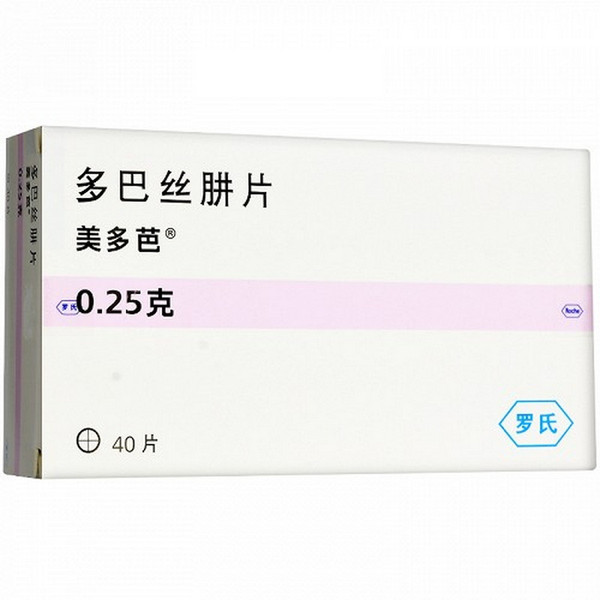
Generic Name: Levodopa and Benserazide Hydrochloride Tablets
Brand Name: Levodopa/Roche
English Name: Levodopa and Benserazide Hydrochloride Tablets
Pinyin: Meiduoba
【Ingredients】
This product is a compound preparation. Each tablet contains 200mg of levodopa and 50mg of benserazide (equivalent to 57mg of benserazide hydrochloride).
【Appearance】
This product is a light red tablet with added coloring agent.
【Indications】
For the treatment of Parkinson's disease and symptomatic Parkinson's syndrome (post-encephalitis, arteriosclerotic, or toxic), but excluding drug-induced Parkinson's syndrome.
【Dosage and Administration】
The optimal daily dose of Levodopa must be determined based on the individual patient's condition.
The following dosage table can be used as a basic reference:
1. Initial Treatment The recommended initial dose is 1/2 tablet of Levodopa three times daily. Increase the daily dose by 1/2 tablet each week thereafter until the appropriate therapeutic dose for the patient is reached. If the patient visits the doctor regularly, the dosage can be increased more quickly, for example, by increasing the daily dose twice a week, adding half a tablet of Madopar each week. This will allow the effective dose to be reached more quickly, typically between 2-4 tablets daily, divided into 3-4 doses. The daily dose rarely needs to exceed 5 tablets of Madopar.
If it is necessary to administer more than 4 tablets of Madopar daily, then dose increases should be made at monthly intervals.
For a small number of patients, the initial recommended dose listed in the table may be too high; the dose should be gradually increased from 1/4 tablet to 1/2 tablet until the same total daily dose is reached.
2. Maintenance Therapy The daily dose of Madopar should be divided into at least 3 doses. The average maintenance dose is one tablet of Madopar three times a day. However, because symptom improvement may fluctuate, the daily dose distribution (regarding the dosage and timing of administration for each patient) will depend on the individual patient's specific situation. If a patient experiences significant fluctuations in treatment efficacy (such as an "on-off" phenomenon), this condition can often be significantly improved by taking 1/4 tablet of Madopar.
In principle, the daily dosage remains unchanged. 1/4 tablet of Madopar can partially or, if necessary, completely replace the original Madopar dosage, but the intervals should be shortened:
The original 1/2 tablet of Madopar can be replaced by two 1/4 tablets taken at once.
The original 1 tablet of Madopar can be replaced by four 1/4 tablets taken at once.
3. Switching from Levodopa to Madopar
If a patient previously treated with levodopa needs to switch to a 1-tablet Madopar, the method is as follows: the daily number of Madopar tablets taken is equivalent to half of the patient's current daily intake of 500 mg/tablet or capsule of levodopa minus 1/2 tablet. For example, if a patient takes 2 grams of levodopa daily (4 tablets or capsules of 500 mg levodopa daily), the doctor should prescribe 2 - 1/2 = 1 + 1/2 tablets of Madopar daily. For all patients, the minimum initial dose is 1/2 tablet twice daily.
The patient should be closely monitored for one week. If necessary, the Madopar dosage should be increased until satisfactory therapeutic effects are achieved (the dosage schedule is the same as for patients who have never been treated with levodopa before). If the patient's clinical condition deteriorates, the dosage increase can be brought forward.
4. General Precautions In rare cases, severe adverse reactions may occur at the beginning of treatment. In such cases, the dosage should not be increased further, and may even need to be reduced. However, it is rare to need to interrupt treatment. When adverse reactions disappear or become tolerable, the daily dose can be increased again, but more slowly, such as increasing by only 1/2 tablet of Madopar every 2-3 weeks. When a patient takes more than their usual effective dose of levodopa (e.g., more than 3 tablets daily), the interval between dose increases should be longer, as it takes time for the drug to achieve its full therapeutic effect.
Like all substitution therapies, levodopa treatment is long-term. If symptoms improve after 4 weeks of treatment, levodopa should be continued to achieve good results. Sometimes, levodopa needs to be taken for more than 6 months to achieve optimal effects.
【Adverse Reactions】
1. Blood and Lymphatic System: Hemolytic anemia, transient leukopenia, and thrombocytopenia have been reported in very rare cases. Therefore, blood cell counts and liver and kidney function should be checked regularly during long-term use of levodopa-containing medications.
2. Metabolism and Nutrition: Anorexia has been reported.
3. Psychiatric Symptoms: Depression may occur in patients receiving levodopa treatment, but this may also be a clinical manifestation of Parkinson's disease and restless legs syndrome. Agitation, anxiety, insomnia, hallucinations, delusions, and transient disorientation may occur in elderly patients or those with a similar medical history.
4. Nervous System: Occult loss or dysgeusia has been reported in isolated cases. Motor disturbances (such as chorea-like movements or choreoathetosis) may occur in the later stages of treatment; reducing the dosage usually resolves the symptoms.
【Contraindications】
1. Madopar is contraindicated in patients with known hypersensitivity to levodopa, benserazide, or their excipients.
2. Madopar should not be used concomitantly with non-selective monoamine oxidase inhibitors (MAOIs), except for selective MAOI B inhibitors (such as selegiline and rasagiline) and selective MAOI A inhibitors (such as moclobemide). Concomitant use of MAOI A and MAOI B inhibitors is equivalent to non-selective MAOIs and therefore should not be used in combination with Madopar (see 【Drug Interactions】).
3. Madopar is contraindicated in patients with endocrine disorders, renal (except dialysis patients), hepatic dysfunction, heart disease, psychosis, or angle-closure glaucoma.
4. Madopar is contraindicated in patients under 25 years of age (must be patients with fully developed bones).
5. Madopar is contraindicated during pregnancy and in women who are not using effective contraception and have a potential for pregnancy (e.g., pregnant or breastfeeding women). If a patient becomes pregnant while using this medication, she should discontinue use (as advised by her prescribing physician).
【Precautions】
1. Monoamine oxidase inhibitors should not be given to patients during treatment with levodopa. Levodopa can enhance the effects of concurrently administered sympathomimetic drugs. Therefore, close monitoring of the cardiovascular system is essential, and the dosage of sympathomimetic drugs should be reduced. Other anti-Parkinson's drugs should not be abruptly discontinued at the start of levodopa treatment, as their effects take at least several days to materialize. In some cases, the dosage of other drugs should be gradually reduced later.
2. Patients with myocardial infarction, coronary artery insufficiency, or arrhythmia should undergo regular cardiovascular examinations (especially electrocardiograms).
3. Concurrent use of various antihypertensive therapies during treatment is permissible, but blood pressure should be measured regularly. Among antihypertensive drugs, reserpine and methyldopa can interfere with the use of monoamine oxidase inhibitors.
【Special Populations】
Precautions for Children: Not suitable for patients under 25 years of age.
Precautions during pregnancy and lactation:
1. Animal studies have shown that Madopar may affect embryonic skeletal development; therefore, it is absolutely contraindicated for use during pregnancy or in women who are not using effective contraception but have a possibility of becoming pregnant.
2. Because it is unknown whether benserazide can enter breast milk, mothers taking Madopar should not breastfeed, as the possibility of skeletal deformities in the infant cannot be ruled out.
Precautions for the elderly: Same dosage and administration.
【Drug Interactions】
1. Pharmacokinetic Interactions 1.1 When the anticholinergic drug trihexyphenidyl (Artane) is used in combination with the standard formulation of Madopar, it can reduce the absorption rate of levodopa, but it does not affect the extent of absorption. Ferrous sulfate can reduce the maximum plasma concentration and AUC of levodopa by 30-50%. Significant changes in clinical pharmacokinetics have been observed in some patients when used in combination with ferrous sulfate, but this does not occur in all patients. 1.2 Metoclopramide can increase the absorption rate of levodopa. 1.3 There are no pharmacokinetic interactions between levodopa and the following compounds: bromocriptine, amantadine, selegiline, and domperidone.
2. Pharmacodynamic Interactions 2.1 Neuroleptic drugs, opioids, and reserpine-containing antihypertensive drugs can inhibit the effects of levodopa. 2.2 When administering levodopa to patients receiving irreversible non-selective monoamine oxidase inhibitors (MAOIs), MAOIs should be discontinued at least two weeks before starting levodopa, otherwise adverse reactions such as hypertensive crisis may occur (see [Contraindications]). However, patients already receiving levodopa may use selective MAOI B inhibitors (such as selegiline and rasagiline) and selective MAOI A inhibitors (such as moclobemide). In such cases, it is recommended to adjust the levodopa dose according to each patient's efficacy and tolerability. Concomitant use of MAOI A and MAOI B inhibitors is equivalent to taking a non-selective MAOI and should therefore not be used in combination with levodopa (see [Contraindications]). 2.3 Levodopa should not be used concurrently with sympathomimetic drugs (such as adrenaline, noradrenaline, isoproterenol, or amphetamines, which stimulate the sympathetic nervous system), as levodopa can enhance the effects of these drugs. If the patient must use these drugs concurrently, cardiovascular responses should be closely monitored, and the dosage of sympathomimetic drugs should be reduced. 2.4 Levodopa can be used in combination with other anti-Parkinson's drugs (such as anticholinergic drugs, amantadine, dopamine receptor agonists, etc.), although therapeutic effects and adverse reactions may increase simultaneously. When used in combination, the dosage of levodopa or other drugs should be reduced. When starting adjunctive therapy with a COMT inhibitor, the dose of levodopa should be appropriately reduced. Because levodopa does not produce therapeutic effects in a short period of time, anticholinergic drugs should not be abruptly discontinued.
3. Levodopa can affect the results of catecholamine, creatinine, uric acid, and blood glucose tests. In patients using levodopa, the Coombs test may show false positive results.
4. Consuming a high-protein diet concurrently may reduce the efficacy of the medication. 4.1 General anesthesia with halothane: Because halothane may cause fluctuations in blood pressure and/or arrhythmias, if halothane is required for general anesthesia, levodopa should be discontinued 12-48 hours before surgery. 4.2 If other anesthetics are used for general anesthesia, see [Precautions].
【Pharmacological Action】
1. Levodopa and benserazide is a compound preparation composed of levodopa and benserazide. Dopamine is a neurotransmitter in the brain, and the dopamine content in the basal ganglia of patients with Parkinson's disease is insufficient. Levodopa is an intermediate product in dopamine biosynthesis and a dopamine precursor, which is converted to dopamine under the action of aromatic L-amino acid decarboxylases. Levodopa can cross the blood-brain barrier, while dopamine itself cannot; therefore, levodopa is used as a prodrug to increase dopamine levels.
2. After administration, levodopa undergoes rapid decarboxylation in extracerebral and cerebral tissues to generate dopamine, preventing most levodopa from reaching the basal ganglia. Peripherally produced dopamine often causes adverse reactions. Therefore, inhibiting the decarboxylation of levodopa in extracerebral tissues is essential. This can be achieved by simultaneously administering levodopa with the peripheral decarboxylase inhibitor benserazide.
3. Levodopa-benserazide is a compound preparation of levodopa and benserazide in a 4:1 ratio. Clinical trials and therapeutic applications have demonstrated that this ratio provides optimal efficacy, comparable to high-dose levodopa alone.
【Storage】
Protect from light, seal tightly, and store in a cool (not exceeding 20°C) dry place. Keep out of reach of children.
【Specifications】
0.25g * 40 tablets
【Packaging Specifications】
Box
【Shelf Life】
48 months
【Approval Number】
National Drug Approval Number H10930198
【Manufacturer】
Shanghai Roche Pharmaceuticals Co., Ltd.